Artificial Intelligence (AI)
1.Trends in AI-based drug discovery
The rapid accumulation of large-scale biological datasets, coupled with advances in artificial intelligence (AI), has accelerated the adoption of AI technologies in drug discovery.
AI models trained on genomic, proteomic and structural data enable the identification and design of novel therapeutic candidates, as well as the prediction of protein–protein interactions and the functional effects of mutations.
Key advancements include protein language models that capture contextual and evolutionary relationships among amino acids, deep learning–based structure prediction models such as AlphaFold and diffusion-based generative models capable of designing novel protein sequences and structures.
These AI-driven approaches are widely applicable to biopharmaceutical development, including antibody therapeutics, protein drugs, vaccines, and immunotherapies, and are expected to significantly improve efficiency while reducing costs.

2. AI Research in our lab
2-1) Antigen-specific antibody sequence generation
Our research focuses on the generation of antigen-specific antibody sequences guided by antigen information.
We develop AI models trained on antigen–antibody interaction data derived from publicly available databases (e.g., OAS, PDB, and SAbDab) in combination with proprietary datasets. These models aim to design antibody sequences with high specificity toward target antigens.
Candidate antibodies are prioritized through computational assessments, including binding affinity prediction and structural stability evaluation, followed by experimental validation via gene synthesis and expression.
This work is carried out within an integrated dry–wet framework, where experimental feedback is iteratively incorporated to enhance model performance.
3. Research strategy for AI-based drug discovery
Artificial intelligence (AI) technologies are anticipated to play a pivotal role in drug discovery, enabling applications such as the prediction of drug–target interactions and assessment of drug toxicity.
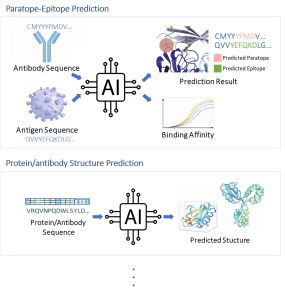
Notably, AI-driven approaches facilitate antibody and protein engineering through paratope and epitope prediction, as well as three-dimensional structural prediction and analysis of proteins and antibodies.
Moving forward, we aim to further expand our research in next-generation biopharmaceutical development by integrating these AI-based methodologies.